DRAGOO’S OIL BLENDS
  • Home & Store
  • About
    • The Owner
  • Guidelines
  • Contact
  • Essential Oil Safety
  • Old Rooster Creek Flea Market
  • Herb of the Month Focus
  • Essential Oil of the Month Focus
  • Carrier Oil of the Month
  • Karen's BLog
  • Monthly Tidbit
  • Recommendations
  • Members Pages
    • Herbal Data Sheets >
      • Angelica
      • Arnica
      • Astragalus
      • Balm of Gilead
      • Bee Balm
      • Burdock
      • Butterfly Weed
      • Calendula
      • Cardamom
      • Chamomile
      • Chickweed
      • Cinnamon
      • Comfrey
      • Cranberry
      • Dandelion
      • Elder Berries & Flowers
      • Elecampane
      • Ginger Root
      • Goldenrod
      • Goldenseal
      • Hibiscus
      • Hops
      • Lavender
      • Lemon Balm
      • Licorice Root
      • Marshmallow Root
      • Mullein
      • Oregon Grape - Mahonia
      • Peppermint
      • Plantain
      • Red Clover
      • Rose
      • Sassafras
      • Sow Thistle
      • Turmeric
    • Essential Oil Datasheets >
      • Allspice
      • Angelica
      • Balsam Copaiba
      • Balsam Poplar/Balm of Gilead
      • Basil, Sweet
      • Basil, Tulsi
      • Cardamom
      • Chamomile, German
      • Chamomile, Roman
      • Elemi
      • Frankincense
      • Galangal
      • Geranium
      • Ginger
      • Helichrysum italicum
      • Hemp
      • Lavender
      • Lemon
      • Orange (Sweet)
      • Plai
      • Ravintsara
      • Rose Absolute
      • Sage (Salvia officinalis)
      • Thyme
      • Vetiver
      • Ylang Ylang
    • Carrier Oils & Butters Datasheets >
      • Andiroba Oil
      • Argan Oil
      • Black Currant Seed Oil
      • Black Seed (Nigella)
      • Borage Oil
      • Castor Oil
      • Cocoa Butter
      • Coconut Oil
      • Evening Primrose Oil
      • Grapeseed
      • Hemp Seed Oil
      • Jojoba
      • Macademia Nut
      • Mango Butter
      • Neem Oil
      • Pumpkin Seed Oil
      • Sacha Inchi
      • Safflower Oil
      • Sea Buckthorn Oil
      • Shea Butter
      • Tamanu
    • Component Datasheets >
      • EO Chemical Constituents >
        • (E)-Anethole
        • Caryophyllene (beta)
        • 1,8-Cineole
        • Humulene - alpha
        • Linalool
        • β-Myrcene
      • Herb Constituents >
        • L-Ascorbic Acid (Vitamin C)
        • Carotene (Beta)
        • Retinol (Vitamin A)
        • Alpha-Tocopherol (Vitamin E)
        • Gamma-Tocopherol (Vitamin E)
        • Saponins
      • Fatty Acid Profiles >
        • Linoleic Acid
        • Alpha-Linolenic Acid
        • Oleic Acid
        • Palmitic Acid
        • Stearic Acid
    • Energetics Charts
    • Topical Recipes >
      • E3 TKO Alt with Beta-Caryophyllene
      • AASK Skin Serum & Soap
      • Comfeet
    • Edible Recipes
    • EO Safety in depth >
      • Children
      • Dilution Rates
      • Oils that may set off seizures
      • Phototoxicity
      • Pregnancy & Breastfeeding
  • Costumes
  • Stitchhouse Powerpoints
    • Floriani Software Lessons

Karen's Blog

Blogs by Karen Dragoo​

My Short Journey With Melanoma

1/13/2020

 
Before you read this, I need to give a warning that there are graphic pictures at the end of the blog.  

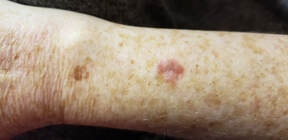
In early October 2019, I had a spot (that looked like a mosquito bite) come up on my right arm.  I didn't pay any attention to it until about two weeks later when I realized that it hadn't gone away, and it had gotten bigger.  So I looked at it more closely.  This was no bug bite.  It was red and white with brown spots - and looked like a small paw print.  My regular doctor check up was scheduled for a couple of days later, so I asked him about it then.  He thought it was sun damage and referred me to a dermatologist for a whole-body check because I have so many keratosis spots.  Image 1 below is the spot on my right arm taken on November 2.

​                                                       Image 1
Picture
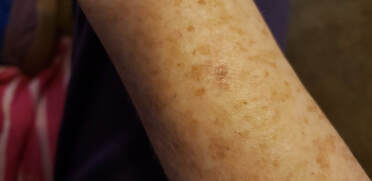
I started taking pictures because the earliest appointment I could get with a dermatologist was the Tuesday before Thanksgiving.  In the meantime, I decided to make a skin serum and apply it to whatever this was.  If my serum helped, I wanted to be able to show the doctor what it looked like before I got in to see her.  Long story short, this lesion turned out to be a Lichenoid keratosis.  Because my serum helped, there wasn't much for the doctor to see - my pics allowed her to make a clear diagnosis without biopsy.  Image 2 shows what this one looks like now.

​                                                 Image 2
Picture
That was the good news.  During the whole-body check, the doctor did find two other spots of concern - one was a small, hard bump on the back of my leg and the other was a red area on my upper left arm.  In the 90s, that patch of skin on my arm had turned pure white - no freckles or pigment at all.  In the last two to three years, it turned pinkish-red and a little scaly.

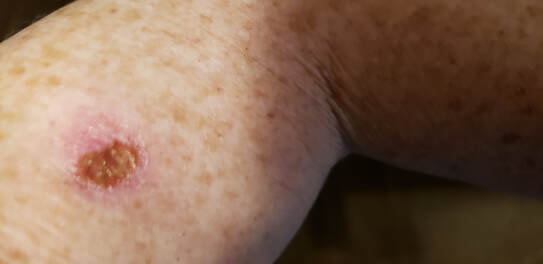
The doctor took a biopsy from each spot and told me that, because of the holiday, it might take up to two weeks before the results came back.  When she called the following Monday, I knew it was a bad sign.  The spot on my leg was fine.  The spot on my upper left arm was melanoma -- the more dangerous kind of skin cancer.  Melanoma is not something to try and cure with food, herbs, or essential oils.  It needs a surgeon.  (Part of my "Hierarchy of Treatment" philosophy.)  Image 3 shows the melanoma after the biopsy.  The scab in the middle is from the biopsy.  The red skin surrounding the scab is the cancer.  There is still a white (no pigment) area around the outside edge of the melanoma.

​                                                                       Image 3
Picture
I am extremely fortunate that this was very slow growing and only Stage 1 because cutting it out is a 100% cure.  Surgery was December 16, and I am considered cured.   Had this progressed to stage 2 or higher, much more treatment would have been required, and the chances of cure would have been lower.

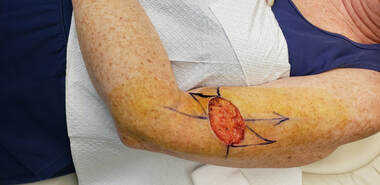
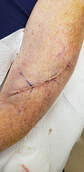
With melanoma, there is a special type of surgery called "Moh's Procedure".  The surgeon removes the lesion and sends it for immediate biopsy.  The incision is bandaged and the patient waits for results.    If there isn't enough margin of clear skin, (biopsy results will specify the edge that isn't clear) the bandage is removed and the surgeon excises more from the indicated area(s).  This is repeated until the proper margin of normal skin cells is achieved.  Once it is attained, the surgeon has to cut more skin out to be able to close and stitch the incision.   (A round or oval excision can't just be stitched together - darts have to be cut at opposite sides to allow it to be closed and stitched.)  Image 4  below shows the open incision before the darts were cut (the purple marker indicates the darts (triangle shapes) he cut right after the picture was taken), and Image 5 shows the final stitching.

​                                                           Image 4
Picture
                                                                        Image 5
Picture
The open incision may look gross to some, but it's also interesting, and pertinent to visualize why oils absorb into our skin so well.  The white, wormy-looking tissue is a layer of fat -- part of the hypodermis.  We also have lipid (fat) cells in our skin.  Oils and butters are also fats, and fats attract fats.

You may ask "Why didn't you get this spot checked sooner?"

My answer is simple -- I never knew that a patch of pink/red skin was a warning sign.  I knew that a mole that changed shape or got darker needed to be checked.  I knew that something that looks like a big wart with blood vessels in it needed to be checked.  I knew that something that has irregular edges and is multicolor needed to be checked.  Even now, when I google 'melanoma images', I find pictures of a lot of things - none of which are a patch of red skin that looks like what I had on my arm.  And this is why I'm sharing my experience and my pictures with you.  If you, or someone you know, develop an area of unusual pink or red skin, go get it checked.  Melanoma is a skin cancer that can spread to the lymph system and to internal organs.  It can be deadly.  

My journey with melanoma was short -- just a few weeks from diagnosis to cure.  Follow-up will take longer.  I'll have skin checks every three months for two years, then every six months for two or three years, then annually for the rest of my life.  I will also need to take a few precautions like keeping my skin covered when I'm out in the sun.  

Because of this experience, I've made some new goals for this website for 2020:  I'll research the various types of skin cancer and keratosis lesions in depth and share what I learn through my blogs.  I'll also experiment with all natural skin serums and butters to support my skin health and to try to minimize development and appearance of my keratosis spots.  

Picture
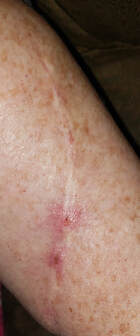
Update:  This is a picture of the scar 28 days post op.  The red area with the small scabs is where the large area was excised and the skin is still stretching.  I've been using a salve I made with carrier oils only plus a lotion with carrier oils and CBD added.  The scar is still puckered, but healing nicely.   In an effort to help the part of my skin that is still stretching, I apply the salve and the lotion to a wide area of my arm.  


Comments are closed.

    Archives

    February 2021
    December 2020
    April 2020
    March 2020
    February 2020
    January 2020
    October 2019
    September 2019
    August 2019
    July 2019
    June 2019
    May 2019
    April 2019
    March 2019
    February 2019
    January 2019
    December 2018
    June 2018
    February 2018
    January 2018

    Categories

    All

    Author

    Karen Dragoo
    Retired Teacher
    Certified Aromatherapist
    ​I'm very fortunate to have found not one, but two callings in life.  The first was teaching -  all ages, all grade levels for 32 years.  


    When arthritis made it no longer feasible for me to continue teaching, my daughter introduced me to the world of aromatherapy.

    The information contained in this blog is for educational purposes only and has not been evaluated by the Food and Drug Administration.
    This information is not intended to diagnose, treat, cure, or prevent any disease.

    RSS Feed

Proudly powered by Weebly
  • Home & Store
  • About
    • The Owner
  • Guidelines
  • Contact
  • Essential Oil Safety
  • Old Rooster Creek Flea Market
  • Herb of the Month Focus
  • Essential Oil of the Month Focus
  • Carrier Oil of the Month
  • Karen's BLog
  • Monthly Tidbit
  • Recommendations
  • Members Pages
    • Herbal Data Sheets >
      • Angelica
      • Arnica
      • Astragalus
      • Balm of Gilead
      • Bee Balm
      • Burdock
      • Butterfly Weed
      • Calendula
      • Cardamom
      • Chamomile
      • Chickweed
      • Cinnamon
      • Comfrey
      • Cranberry
      • Dandelion
      • Elder Berries & Flowers
      • Elecampane
      • Ginger Root
      • Goldenrod
      • Goldenseal
      • Hibiscus
      • Hops
      • Lavender
      • Lemon Balm
      • Licorice Root
      • Marshmallow Root
      • Mullein
      • Oregon Grape - Mahonia
      • Peppermint
      • Plantain
      • Red Clover
      • Rose
      • Sassafras
      • Sow Thistle
      • Turmeric
    • Essential Oil Datasheets >
      • Allspice
      • Angelica
      • Balsam Copaiba
      • Balsam Poplar/Balm of Gilead
      • Basil, Sweet
      • Basil, Tulsi
      • Cardamom
      • Chamomile, German
      • Chamomile, Roman
      • Elemi
      • Frankincense
      • Galangal
      • Geranium
      • Ginger
      • Helichrysum italicum
      • Hemp
      • Lavender
      • Lemon
      • Orange (Sweet)
      • Plai
      • Ravintsara
      • Rose Absolute
      • Sage (Salvia officinalis)
      • Thyme
      • Vetiver
      • Ylang Ylang
    • Carrier Oils & Butters Datasheets >
      • Andiroba Oil
      • Argan Oil
      • Black Currant Seed Oil
      • Black Seed (Nigella)
      • Borage Oil
      • Castor Oil
      • Cocoa Butter
      • Coconut Oil
      • Evening Primrose Oil
      • Grapeseed
      • Hemp Seed Oil
      • Jojoba
      • Macademia Nut
      • Mango Butter
      • Neem Oil
      • Pumpkin Seed Oil
      • Sacha Inchi
      • Safflower Oil
      • Sea Buckthorn Oil
      • Shea Butter
      • Tamanu
    • Component Datasheets >
      • EO Chemical Constituents >
        • (E)-Anethole
        • Caryophyllene (beta)
        • 1,8-Cineole
        • Humulene - alpha
        • Linalool
        • β-Myrcene
      • Herb Constituents >
        • L-Ascorbic Acid (Vitamin C)
        • Carotene (Beta)
        • Retinol (Vitamin A)
        • Alpha-Tocopherol (Vitamin E)
        • Gamma-Tocopherol (Vitamin E)
        • Saponins
      • Fatty Acid Profiles >
        • Linoleic Acid
        • Alpha-Linolenic Acid
        • Oleic Acid
        • Palmitic Acid
        • Stearic Acid
    • Energetics Charts
    • Topical Recipes >
      • E3 TKO Alt with Beta-Caryophyllene
      • AASK Skin Serum & Soap
      • Comfeet
    • Edible Recipes
    • EO Safety in depth >
      • Children
      • Dilution Rates
      • Oils that may set off seizures
      • Phototoxicity
      • Pregnancy & Breastfeeding
  • Costumes
  • Stitchhouse Powerpoints
    • Floriani Software Lessons